- Oscar Brand
-
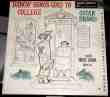 Bawdy Songs Goes To College
[ca. 1960]
Bawdy Songs Goes To College
[ca. 1960]

- The Girls From Campus Hall Time: 1:52
- Four-letter Words Time: 2:40
- Study In Anatomy [aka The Portions of a Woman] Time: 2:27
- Drinks All 'Round [aka Peter Murphy Had A Dog OR Ask Me No Questions] Time: 2:19
- Seniors In Town Again Time: 1:41
- Glorious [aka The Soldier and the Sailor w/Glorious One Keg Chorus] Time: 2:16
- M.O.T.H.E.R Time: 1:15
- Was It You Who Did The Pushing? Time: 0:37
- The More Vulgar-minded Time: 1:38
- Ride On Time: 1:29
- The Duchess And The Student Time: 2:58
- Old Soldiers Never Die [variant on The Sailor's Wife with different chorus and tune] Time: 2:33
- Four For Three [aka Lydia Pinkham] Time: 3:01
- The Codfish Song Time: 2:07
- Father's Grave Time: 1:52
-

Side 1
1. The Girls from Campus Hall
2. Four-Letter Words
3. Study in Anatomy
4. Drinks all 'Round
5. Seniors in Town Again
6. Glorious
7. Correspondence
Side 2
1. The More Vulgar-Minded
2. Ride On
3. The Duchess and the Student
4. Old Soldiers Never Die
5. Four for Three
6. The Codfish Song
7. Father's Grave
AUDIO FIDELITY AFLP 1952
BAWDY SONGS
Goes to College
Oscar Brand, guitar-Dave Sear, banjo
Every fraternity house, every college smoker, every faculty dining room is a hotbed of bawdy songs. Every college man is the inheritor of a legacy of ribaldry which has been passed on in a direct progression from the students who matriculated with Abelard, Schiller, and Rudyard Kipling. But let us not forget the words of the old song:
"Here we are now all singing about it,
The reason is simple, were doing without it."
Yes. Despite the sensational stories told by newspapers and magazines, students have more important things to do than eat goldfish, crowd into telephone booths, and stage panty raids on the dormitories of the opposite sex. Most students are quiet, studious, and decorous—anxious to preserve morality and order in our untidy world.
However, we repeat that they excel in one wild field—the creation,
re-shaping, and perpetuating of bawdy songs. Each of the songs in this album
was college-bred or university-nurtured. Each was the favorite of some
fraternity or house plan. Each has been refurbished over the years with
local allusions, and beer-inspired fancies. Each was volunteered by some
young man or woman after one of my many college concerts—during which I am
privileged to sing back at the accumulated faculty and student body the very
songs they have so generously shared with me.
THE GIRLS FROM CAMPUS HALL (BARNARD)
Singing a lecture to a woman's college usually brings me a fine catch of reception-party ribaldry. As the ancient song puts it:
"If all them young ladies were singing this song, 'Twould be five times
as bawdy and ten times as long." This is probably one of the few truly bawdy
songs which have been created on local campuses and can be classed as
indigenous culture.
FOUR LETTER WORDS (M.I.T.)
Just a few weeks before the recording date for this LP, I performed a
concert at M.I.T. just after the ending of their annual "glove fight." A
young freshman, with nine fingers. pressed a typewritten sheet of paper into
my hot palm and left without leaving his name. The song is sung herein as
typed, with a newly-composed melody. If the young man will declare himself,
he will receive a free album, and, possibly, immediate dismissal from the
Institute.
STUDY IN ANATOMY
This song must be credited to whichever school of higher education boasts
of the matriculation of Literary Giant Christopher Sorley. I have never seen
the original poem in print, but accumulated the material line by line over a
period of ten years. The melody was created the night we recorded this
album—about one minute after Sidney Frey called out, "Let's Record it!"
DRINKS ALL 'ROUND (DENVER)
The melody and many of the words were supplied by John Runge,.but the
cement which finally made the song possible for recording was applied by a
School of Mines student backstage at Denver's "Exodus" Club. The song has a
sneaky way of avoiding the nasty words expected of it which reminds one of
"The Clean Song" (Vol. V, 1884) and "Sweet Violets" (Vol. IV, 1847).
SENIORS IN TOWN AGAIN (DARTMOUTH)
Originally, I heard this to another tune as "Dartmouth's In Town Again."
The words were bawdier, but localized to a provincial degree, so I turned to
a more generalized version. No one but a Dartmouth man should be allowed to
denigrate his alma mater to such a violent degree.
GLORIOUS: (CCNY)
Years ago I viewed a motion picture called "The Last Will of Doctor
Mabuse" in which the good doctor sang the chorus of a song that sounded like
"Glorious, Glorious." Inquiring, I was referred to this recorded version by
members of the faculty of Brooklyn College of the College of the City of New
York (BC of CCNY). It was a stroke of good fortune and human error, for the
motion picture song, it turned out, was not this gem at all, but a German
Army anthem, "Gloria Victoria." The version enclosed is a combination of
"The Souse Family," and a Christ College drinking song.
CORRESPONDENCE (COLUMBIA)
Among the "Songs For Oarsmen" published surreptitiously by alert
undergrads, and shown to me by Steve Werdenschlag, I found this
heart-rending series of letters. The first section, of course, is a parody
of "MOTHER," the second section is composed of additional verses to
"Humoresque" (Vol. III, 1824).
THE MORE VULGAR-MINDED (NORTHWESTERN)
I first met this song while singing a series in Illinois. The singer was
an inebriated coed in Evanston. The L H Gordon, a helpful friend, brought
back additional verses after a trip to Paris. Finally at Northwestern, an
associate Professor supplied the remaining material. He'd made up some new
verses, but only advance Biology Majors could have understood them.
RIDE ON (TEXAS)
The southwestern singer had many different kinds of song, each suited to
his work of the moment. For instance there were "fast-riding songs,"
"loping-along songs," "shout-herding songs," "croon-herding songs," etc.
This version is of a fast riding song which is used for that purpose by many
students who never bother with horses.
THE DUCHESS AND THE STUDENT (OXFORD)
This is a contemporary version of the ancient song, "The Jolly Tinker"
(Volume 3, AFLP 1824), with a new approach provided by England's John Runge.
In the old days, the Tinker or Gypsy was ascribed miraculous sexual prowess.
In fact, the word "glamour" comes from a Romany technique for making men
irresistible. In the new song, probably because of wishful thinking, a
student is the hero.
OLD SOLDIERS NEVER DIE (UTAH)
Here again is an example of two songs fused to make a single item of
perfection. The chorus is probably the more recent addition, stemming from
the Regular Army favorite lately a hit pop-song. The verse is related to
"You're A Liar" (Vol. V, AFLP 1884) and to an old Scottish song bowdlerized
by Robert Burns to make "Green Grow The Rashes-o."
FOUR FOR THREE (MINNESOTA)
The fellow who taught me this one must have spent some time in the van of
the Salvation Army, because he kept pounding on a nonexistent bass drum
during the singing. This may well have been America's first singing
commercial. Every campus has its own version of the songs, since each man
passes it on and one woman tells another.
THE CODFISH SONG: (CAMBRIDGE)
One of the oldest songs in the English language, this rouser is possibly
a translation of a French Goliard ballad. It was once known (during
Chaucer's time) as "The Old Crab Song," and a crab was the inhabitant of the
chamber pot. The idea of a back-biting codfish came later, and seems a
little less painful.
FATHER'S GRAVE (UCLA)
Every university in the country has a version of this song, but in England even the prep schools were hep to it. After spending long hours figuring out statistics of acquisition, I concluded that a UCLA sophomore had won the credit for his University by having supplied 1.25 more verses than any other single contributor. Of course, as with many of our finest ribald songs, the entire production is of British design.