Below is the raw OCR of "Songs of Easter Idaho" by Kenneth Larson. If you wish to verify the text, please download the PDF of the scanned pages.
SONGS OF EASTERN IDAHO
(A Graduate Paper for "American Folklore")
By
Kenneth Larson
University of Utah
Salt Lake City, Utah
Nov. 30, 1950
TABLE OF CONTENTS
1. "The Wedding Party"....... 1
2. "Banks of the Bonnie Dee"..... 3
3. "The Damsel from Chashaw" ..... 4
4. "The Jolly Shepherd" . 6
5. "Bryan O'Lynn" 7
6. "Young Johnnie Doyle".......9
7. "When I Was Single" . . .... . . 11
8. "Wish I Was Single" ........ 13
9. "The Lowlands Low" . . . . .. . . 14
10. "The Two Crows"..........17
11. "Andy Bardeen" . . ..... ... 19
12. "Three Men" ............ 21
13. "Sam Bass" ... . . .......22
14. "Lake of Pongatrain".......23
15. "The Boston Burglar" .... . . . . . 24
16. "Yippie Yay" ........... 25
17. "Creation" ...... 23
Animal Ballad
Sharp, No. 220*
1.
THE WEDDING PARTY
(Secured from Andie Talbot, of Malad, Idaho, in the summer of 1932)**
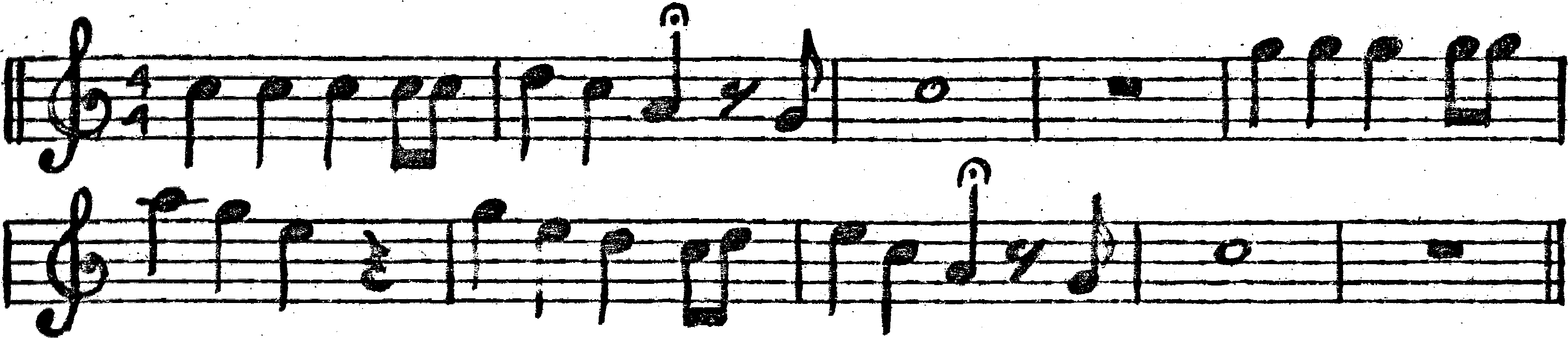
This version, of a ballad commonly called "The Frog's courtships,"
was sung in pioneer days by my grandfather, Stephen Barton Talbot, who
traveled about considerably in Utah and eastern Idaho. A choir leader
wherever he chanced to live, he was also a popular entertainer at par¬
ties and dances, where he often sang songs, accompanying himself on
the banjo. He may have picked up this ballad from some other local
singer* Or he may have acquired it from his parents, Mr. & Mrs. Henry
Talbot, of Kaysville, Utah, who, both born in London, came to utah as
Mormon converts from South Africa in 1861. I like to think the Tal¬
bots brought it with them from England.***
Old lady mouse came a-rattling down,
Haw-haw;
Old lady mouse came a-rattling down,
Dressed in silk and a satin gown,
Haw-haw!
The old bullfrog he took her on his knee,
Haw-haw;
The old bullfrog he took her on his knee;
He says to her, "Will you marry me?"
Haw-haw!
Where is the wedding supper going to be?
Haw-haw;
Where is the wedding supper going to be?
A-way down yonder in a hollow tree!
Haw-haw!
What's the wedding supper going to be?
Haw-haw;
What's the wedding supper going to be?
A chunk of cabbage and a cup of tea!
Haw-haw!
The first come in was a big black snake,
Haw-haw;
The first come in was a big black snake;
He swallowed up all the jelly-cake,
Haw-haw!
The next come in was a little bitta bee,
Haw-haw;
The next come in was a little bitta bee;
He carried a fiddle on his knee,
Haw-haw!
(1, The Wedding Party)
Next come in was a bumblebee,
Haw-haw;
Next come in. was a bumblebee —-
Danced a jig for the little bitta bee,
Haw-haw!
The old bullfrog he jumped in the lake,
Haw-haw;
The old bullfrog he jumped in the lake,
And he got bit with a big black snake,
Haw-haw!
The big black snake he swum to the land,
Haw-haw;
The big black snake he swum to the land,
And he got killed by a niggero man,
Haw-haw!
The niggero man he went to the war,
Haw-haw;
The niggero man he went to the war,
And he got killed with a big snowball,
Haw-haw!
The big snowball it laid on the ground,
Haw-haw;
The big snowball it laid on the ground,
Till it got melted with the sun,
Haw-haw!
Now, lay my book upon the shelf,
Haw-haw;
Now, lay my book upon the shelf;
If you want any more, you can sing it yourself,
Haw-haw! * ** ***
Sharp, Vol. II, Nos. 220,
Gardner & Chickering, No.
Henry, No. 144, p. ¿92
Eddy, No. 44
Scarborough, p. 46
Cox, No. 22, p. 56
*Various versions appear, also, under such titles as "The Frog and
the mouse, " "Master Frog Went A-Courting, " and "The Frog in the Well."
Primary References Secondary References
221 Mackenzie, pp. 373-374
189 Greenleaf & Mansfield, p. 90
Campbell & Sharp, No. 119
Flanders & Brown, p. 122
Stout, p. 30
Thomas, p. 154
**Andie Talbot, my uncle, is about 60, a prosperous farmer with large
family, and quite active in community affairs. He recited most of
the ballad but sang the first stanza so I could record the music also
As far back as his memory went, to at least 1900, he could recall his
father's singing this and many other songs in the evenings with his
children around him.
***Child apparently did not consider this ballad worthy of conclusion in
his collection. Yet, he had access to it, for it has enjoyed wide¬
spread popularity for four hundred years. Kittredge says (JAFL,xxxv,
pp. 394-399) that the earliest version is mentioned in Wedderburn's
Complaint of Scotland (l549), and that it was licensed to Edward
White at Stationer's Hall, London, in 1580. It seemingly still has
great popularity throughout England, America, and many other parts of
the world, as a nursery and game song.
Unhappy Love Ballad Eddy, No. 104*
2.
BAMS OF THE BONNIE DEE
(Learned in childhood from my mother, Mrs. Leff Larson, Malad, Idaho)**
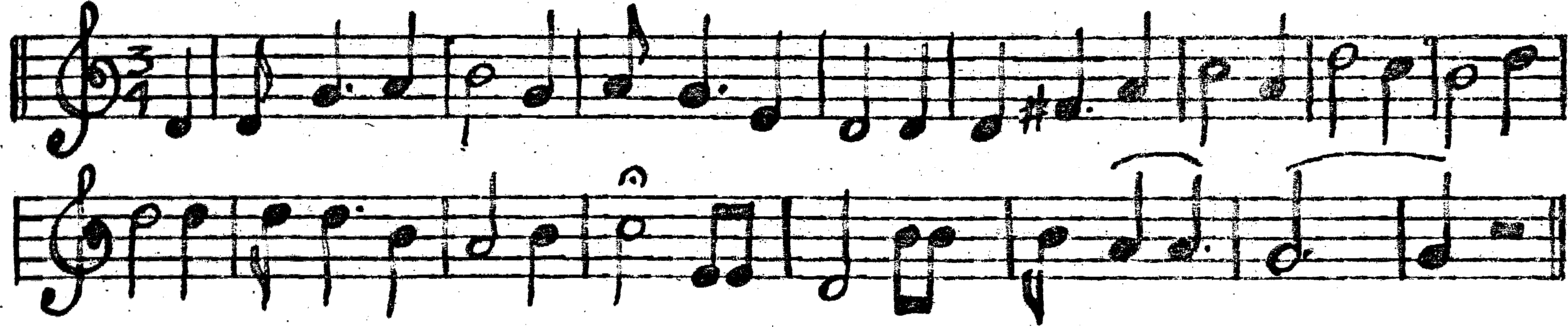
I remember hearing this fragment of an old ballad, widespread in
other versions as "The Cruel Mille" or "The Wexford Girl," as early
as 1910. In my childhood, mother sang it to me often. She claims to
have learned it from her father, Stephen Barton Talbot, during the
singing sessions the family habitually held in the evenings at home.
- But it undoubtedly goes back further, to the Henry Talbot home of Kays-
villa, Utah, and perhaps even to Grahamstown, South Africa, or even to
London, England. The Talbots seemingly brought many such songs with
them to this country by way of South Africa.***
Oh, Father dear, what deed have I done;
What deed have I done this very day?
Oh, I have murdered my own true love
On the banks of the Bonnie Dee!
She said that she would never be mine,
That her true heart would ever be
Where the murmuring waters flow,
On the banks of the Bonnie Dee!
I took her by her lily-white hand
And whirled her round and round and round;
I whirled her round and round and round,
And watched her body drown!
Oh, Father dear, what deed have I done;
What deed have I done this very day?
Oh, I have murdered my own true love
On the banks of the Bonnie Dee.
*Versions of the ballad are variously called"The Jealous Lov-
er," "Banks of the Old ” "Lonely Valley," "The Terrington
Girl, "also "Banks of the Obadee."
Primary References Secondary References
Gardner & Chickering, No. 20, p. 80 Mackenzie, No. 115
Henry, No. 64, p. 214 Scarborough, p. 151
Eddy, No. 104, p. 231 Fuson, p 65
**My mother, a housewife, is now 65, and still remembers these old
songs. Born in Rockland, Idaho, in 1885, she lived with her
parents at Leamington, Kaysville, Ogden, and various other towns in
Utah. Her father was a wandering laborer and land settler.
***I can find no comparable ballad in Child. Yet, this theme has had
wide circulation in America, and probably originated.....in England.
Versions of it will probably show up in some of the English collec¬
tions.
Outlaw Ballad Child, No. 283
3.
THE DAMSEL FROM CHASHAW
(Secured from Grandma: Katie Talbot, of Blackfoot, Idaho, about 1932)
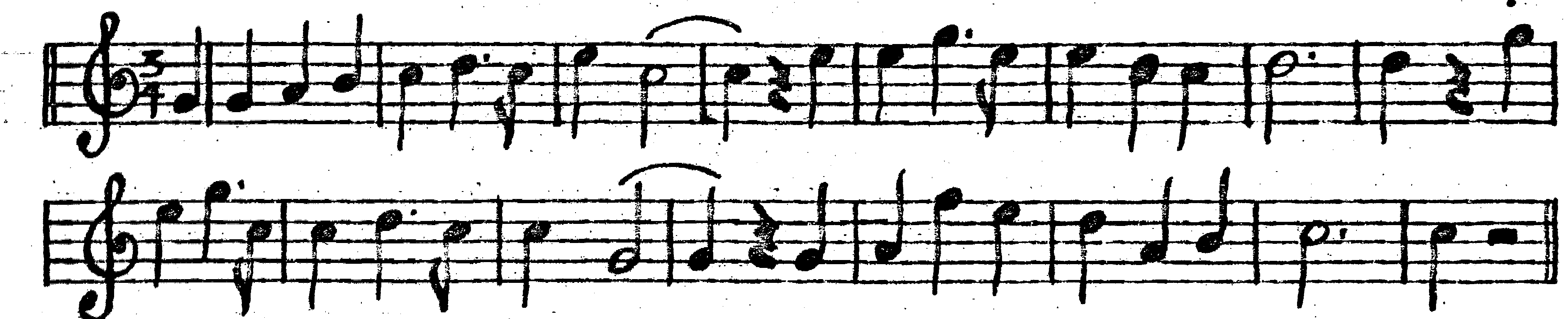
This is another of the old ballads my mother used to sing to me
as a child. And I, in turn, while in grade school at St. John, Idaho,
used to do it with my sister, Ethel, at the Friday afternoon programs.
We didn't know then, of course, that the "Chashaw" was a corruption of
"Cheshire." My mother tells me that this ballad, too, was brought to
America from England, via South Africa, in 1861 by the Talbots. The
present completed version was mailed to me, on request, in 1932, by my
grandmother, Katie Talbot, of Blackfoot, Idaho.
There lived a fair damsel in Chashaw
Who often to market would go,
Thinking no one would harm or molest her
As she traveled the road to and fro.
She met with a lofty highwayman;
Two pistols he held at her breast,
Saying, "Stand and deliver your money,
Or else you will die, I confess!"
He stripped this poor damsel most naked,
And took from her wallet her gold;
And as he sat counting her money,
He gave her the bridle to hold.
She put her foot into the stirrup,
And into the saddle she sprang;
And away she dashed over the prairie,
Crying, "Catch me, bold rogue, if you can!"
She dashed over hills and high mountains
Till she came to her father‘s farm-side;
And then with a tear and a whisper,
Her father he then did arrive.
"Oh, daughter, oh, what's been the matter,
That's kept you so long from the farm?"
"Oh, enough, oh, enough s been the matter,
But the rogue he has done me no harm!”
She split her black mantle wide open,
And spread it all over the floor;
And there she sat counting her money,
Till she counted five thousand or more.
"Oh, daughter, you have a fine fortune,
And. I'll give you twice that much more;
And then you will have enough money
To keep the cold wind from your door!"
(3, The Damsel from Chashaw)
This damsel she still lives in Chashaw;
Her husband along with her dwells;
And the little ones they all sit and listen
While the story of the robber she tells. * ** ***
*The correct title of this ballad seems to be "The Damsel from Che¬
shire." There are, however, variants called "The Highway Robber"
and "The Maid of Rygate. But of all the books I examined, I found
one in only Greenleaf and Mansfield. The references which follow
are from this book and from Child:
Logan, A Peddler's Pack, pp.134-136
Greenleaf & Mansfield, No. 21, p. 47
Child, Nos. 112 & 283
Leigh, Ballads of Cheshire, pp. 267-268
Sharp & Marson, Folk Songs from Somerset,
No.50, II, 50-51
Ravenscroft, Deuterome lia, London, 1609
Fills to Purge Melancholy. III, 37, 1719
Percy's Reliques, III, 238, 1765
Pepy's Ballads. V, Nos. 162-164, 1765
Ritson's Ancient Songs, p.159, 1790
**My grandmother learned this song from her husband, Stephen Barton
Talbot. She herself was a native of Leamington, Utah, born of par¬
ents who had come from Denmark to this country as Mormon converts.
Her memory is excellent.
***Child has no version which closely resembles "The Damsel from Che¬
shire." His "Crafty Farmer" (No. 283), however, is a good mascu¬
line parallel. And his "Baffled' Knight” (No. 112) in its many
form has a similar theme but is somewhat differently told.(It
better conforms to my "Jolly Shepherd," Ho. 4, which see.) Ordi¬
narily a knight, or perchance a highwayman, catches a young girl
in compromising circumstances and attempts to seduce her, but with
false promises she tricks him into seeing her home, only to lock
him out and then to mock him from a safe retreat. But there are al
so cases where she escapes with his horse and money. Such is true
in a modern French ballad, attributed by Child to Favart, where,
to save her honor, the lady robs the highwayman not only of his
horse but of his valise, containing his money. This latter is
Child's closest approach to "The Damsel from Cheshire," which,
though fairly common in England, seems to be rather rare in the
United States. There are numerous versions of the "Baffled Knight,
•however, not only in English, but in Spanish, French, Portuguese,
Danish, and German.
Vulgar Ballad Child, No.112
4.
THE JOLLY SHEPHERD
(Learned by Leff Larson about 1900 from Abraham Stephen Hansen)
This modernized version of "The Baffled Knight" was transmitted
to my father by a sheepherder. They were, at the time, herding to¬
gether in grassy Pocatello Valley, a few miles west of Malad, Idaho*
Hansen knew many such songs and rendered them to his own accompaniment
on the banjo.
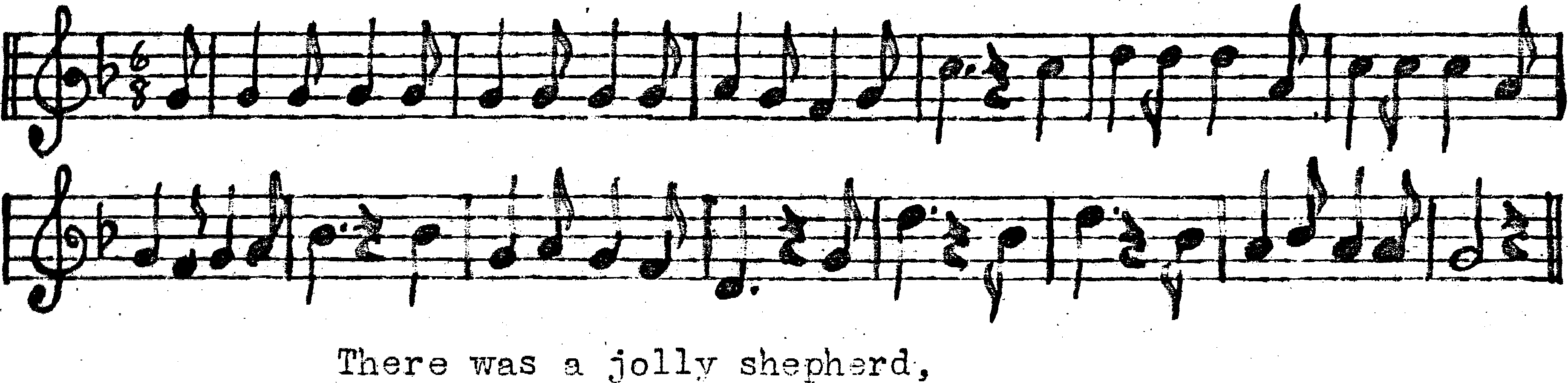
And he lived upon a hill;
He went out hunting one fine day
To see what he could kill.
Sing fal-der-al-dal der-riddle all the day.
He looked to the east and then to the west,
And then he took another look;
And there he spied a maiden fair
A-swimming in the brook. _
Sing fal-der-al-dal der-riddle all the day!
He sneaked down through the bushes
To get a closer look,
And peeked upon this maiden fair
A-swimming- in the brook.
Sing fal-der-al-dal der-riddle all the day!
They traveled along together
Till they came to a stack of hav;
She said, "It'd, be a pretty place
For you and me to play!"
Sing fal-der-al-dal. der-riddle all the day!
They traveled along together
Till they came to a patch of clover;
She said, TTitM by. a pretty place
For you to roll me over; 11
Sing fal-der-al-dal der-riddle all the day!
They traveled .along together
Till they came to h-^r father's house;
And then she said, "I'm a m.a:d within,
And you're a fool withouti "
Sing fal-dex'-al-dal. d-^r-r idd le all the day!
*For references and history of origin see the preceding ballad, "The
Damsel from Cheshire,"
**5uch songs are common in the shearing corrals of th
seem, to follow the lines of the old Child material,

And they
tnere^s, bn the
contrary, those from the cowl camps are moi
or
\no
n n -5 -p X
i-,.4 e
to
the local life* Is it'bocau
Humorous Ballad Sharp, No. 151*
■' -5.
BE YAH 0 'LIMN
I have found two auite different, versions of this son?;. Both,
unfortunately, are without music, though the. first half of the "Irish
Washerwoman" has been suggested as the probable tune. The first was
recited to me by Mrs. Frank Grant shortly after I began collecting.
At the time,, the Grants were buying a farm near fiden, Idaho. But they
had. come d^est from St. Louis, Missouri, their original home, several
years earlier, and it was there that she had learned the words as a
child. The second version ms given to me by my father, Leff Larson,
of Malad, Idaho» who learned it at some early-day community gathering.
Both bear considerable resemblance to the pre-Elizabethan original and
to current versions of the Appalachians.**
A. '
(Secured from Mrs. Frank Grant, «ef^Eden, Idaho, in the fall of 1932)
Oh, Bryan O'Lynn,
His wife, and her mother,
They all went over
A bridge together;
The bridge broke down — '
They all fell inp
"There*s ground at the bottom, *
.Said Bryan .0'Lynn.
Oh, Bryan O'Lynn,
His wife, and her mother,
They all slept
-In one bed together;
The night was cold,
And the blankets were thin:
"I'll sleep in the middle.'"
Said Bryan 0'Lynn.
Oh, Bryan O'Lynn
Had no breeches to wear;
He bought him a sheepskin
And made him a pair —
The fleshy sid^ out
And the wooly side in:
"It * s warm in the summer l "
Said Bryan O'Lynn.
Oh, Bryan O'Lynn,
His wife, and her mother,
They all sat down
At the table together;
Two plates and a platter,
But nothing for him:
"I’ll eat from the platter.*
Said Bryan 0‘Lynn.
Oh, Bryan 0 * Lynn
Had no antch to wear;
So he got him a turnip
And scooped it out fair;
He planted a cricket
Right xindar it's skin;
"They'll think it’s a-tickingi"
Said Bryan O’Lynn.
(5, Bryan O'Lynn)
B.
Tumble Lvnn
(Secured from Luff Larson, of Malad, Idaho, in the fall of 1932)
Oh, Tumble Lyirn
Had an old gray mare;
Her hips were thin
And her sides were bare;
Her backbone showed
Through her tough old skin:
"She'll do to so courtingi "
Said Tumble Lynn.
Tumble Lynn stopped
At the Dutchman's hall;
And off he jumped
Among them all;
"You fooli- You fool.'
Why did you come in?"
"I've come a-courtingi "
Said Tumble Lynn.
"Which one of my daughters
Do you love best?
Take your pick
•And leave the rest"
"I'll take some for beauty
And some for skin.'
Oh, I'll take them all'' "
Said Tumble. Lynn.
♦Other titles, all from Child, are "Tam Lin, " "Thom of Lyn, " "Young
Thomlin," and "A Ballet of Thomalvn.". See the following:
. Child, Ho. 39 ("Tam Lin")
Sharp, Ho. 151
Lomax, Our Singing Country, p. 117
Wells, pp. 162, 167
♦♦Though Child has many reference s0;from 1649 to 1844, I here
omit
them, since his "Tam Lin" is a tale of fairy enchantment seemingly
unrelated to our present "Bryan O'Lynn." His earliest reference,
however, is to an identifying comment in Vedderburn's Complaint of
Scotland'. And it is apparent that all versions of "Tam Lin" are re¬
stricted to that country. As for "Bryan O'Lynn, " it, too, dates
, back to pre-Elizabethan days; for, -according to Evelyn Kendrick
Wells, in her The Ball ad. Tr e e (p. 162the song is a very old pre-
Elizabethan satire, mentioned in a pre-Elizabethan play. And in
thu'18th century It was used, in modified form, as a political lam¬
poon against Sir Robert Walpole, M.P. for Ly/nn. Since it is repor¬
ted in various versions for this country, by Sharp, Lomax, and
Wells, it- must enjoy, here, quite a wide spread distribution. I, my¬
self, have unearthed it both in Missouri and in Idaho.
Unhappy Love Ballad
6.
YOUNG- JOHNNIE DOYLE
(Obtained from Melba Ehrnfalt, Me Gammon, Idaho,
Sharp, No. 83*
in the spring of 1933)
I was teaching English In 1933 at the McCammon High School. And,
my request, several of the students, including Miss HhrnfeIt,
brought ballads to class which they had coaxed out of grandparents or
other aged people# ¿nd' this ..little Isolated pioneer community proved**
.. a rich field for the collector. Miss .Ehrnfeltfs aged grandmother,
with whom she lived, readily produced this excellent version of HJohn-
nie Doyle.”*** Unfortunately, 1 did not get the music.
. It happened to be on one Saturday night
That me and Johnnie Doyle were a-talking of a flight;
My hand-maid standing by me was nlain to see;
She went home and told mv old mother on me.
My mother she confined me up in a room so high,
Ihere no one could see me and no one pass by: .
She bundled up, my clothes, and she bid me be gone;
So slowly and so slyly I stepped along. ^
My father called me back again into his chamber door,
Saying, "Daughter, dearest daughter, if you*11 marry
Sandy Moore;
For to marry Johnnie Doyle no pleasure you will have;
I*d rather see your body borne down into the graved”
The coach and six horses her father did provide,
And six noble riders to ride by her side;
They rode bill they came to Edinburgh Town;
ihey called * on Samue l God swell-, ' and there they got
down.
The minister was sent for; he opened the door;
Her diamond rings they bursted and fell to the floor;
In fifty-five pieces her stay-laces.flew;
One would, think her poor heart would of broken in two!
It was by* her eldest brother that she was carried
home;
up in her bed-chamber he softly laid her down;
So sick and so weary her poor body she found,
She was "wishing she were dead and laid under the
ground.
Her mother in'her mourning-gown came a-trioping down
the stairs,
A-wringing of her hands and a-tearins: of her hair,
Saying, "Daughter, have the pleasure, for I m sure I
have the toil;
1 wish you had married Young Johnnie Doylel"
MI111 send, for Johnnie Doyle, dearest daughter, for
you;
I111 send for Johnnie Do"rle, your old lov^r so true.1 ,T
"To send for Johnnie Doyle, dearest mother, you*re
too late;
I am so sick and weary; cold-hearted is my fatei Tf
(6, Youn^ Johnnie Doyle)
"Fray, brother, hold the door till the darming of the
day;
Pray, brother, hold the door and keep Sandy Moore
- av.-ay;
For death is approaching, and that mil end the strife,
For he never shall endoy me to call me his wife i "•
In came Sandy Moore at the dawning of the day;
In came Sandy Moore, and she held, her face away;
She held her face away and died with a smile,
And the last word they heard her say 'was, MYoung John¬
nie Doyle In
♦The title of this song seemingly-does not vary greatly from place
to place« Yet, it is fairly common, not only in this country but
in England and Ireland as well. See the following;
Primary References
Sharp, Vol. 1, Mo. 83
Gardner eb Chickering, No. 69
Henry, No. 40, p. 162
Mdy' No. 73, p. 187
»♦■Settlement at MoGammon probably
Secondary References
Mackenzie, No. 34, po. 106-107
Scarborough, pp. 248-250
Campbell <fe Sharp, No. 83
Phillips Barry, No. 55
began in 1863 with the establish¬
ment of the Portneuf station of Oliver and Conover*s stage line be¬
tween Salt Lake City and Virginia City, Montana. Lata in 1876 the
first railroad passed through. And the town .just missed becoming a
division pointy and achieving the importance which went to Pocatel¬
lo, instead, through the maneuverings of its leading citizen, H.O.
Harkness, This enterprising business man, who had long reaped huge,
profits from a system of local toll-roads, thought to.. capitalize on .
the coming of the railroads, which had ruined the freighting busi¬
ness. So he bought up all the available space for the proposed
townsite and held it at an unreasonable price. But the railroad by¬
passed the town and went on north, where land was cheap and un¬
claimed. The town was named, nevertheless, for Joseph K. McCammon,
representative of the railroad, who reached the agreement with the
Indians of Fort Hall for a right-of-way. And McCammon has remained
an isolated little village dependent for its livelihood on dairying
and dry-farming.
♦»♦Sardner and Chickering say that T1Johnnie Doyle n
was once popular in
¿kigland and Ireland as a broadside song. And Mellinger Henry speaks
of it, in its older form, as an Irish street ballad. It is not,
oeunss, found in Childs collection.
Domestic Ballad
Eddy, Ho. 69*
8.
TOM I WAS SINGLE
(Learned as a child from my parents, at Maiad, Idaho)
As far back as childhood memory goes, 1 recall hearing this old
song sung by my father and mother.- It was apparently community prop¬
erty, for everybody at Ualad seemed to know it, "hatever its origin,**
one person learned it readily from another, for it seemed, to empress
well the prevailing dissatisfaction with the responsibilities and dis¬
appointments of matrimony,*** :
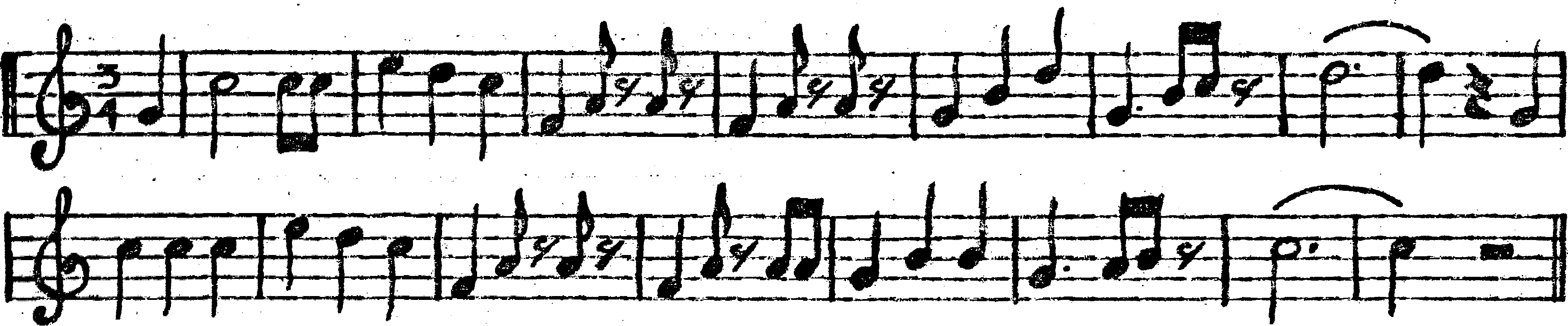
Oh, when I was single,
Oh, then, oh, then;
Oh, -when I was single,
Oh, then;
Oh, when I was single,
My pockets would jingle,
And I long to be single againJ
My wife got a fever,
Oh, then, oh, then;
My wife got a fever,
Oh, then;
My wife got a fever,
And' I hope it don't leave her,
For I long to be single againj
My wife she died,
.Oh, then, oh, then;
My -wife she died,
Oh, then;
My wife she died,
And I laughed till I oried,
Because I was single againi
Went off to the funeral,
Oh, then, oh, then;
Went off to the funeral,
Oh, then;
I heaved and I sighed,
And I laughed till I cried,
And I started off courting againJ
I married, another,
Oh, then, oh, then;
I married another,
Oh, then;
I married another,
The Devil's grandmother,
And I long to be single again.'
(7, ühen I Was Single)
Be good to the first,
Oh, then, oh, then* * ***
Be good to the first,
’•Oh, then*
Be good to the first,
For the last is the worst,
And you’ll long to be single again!
*This popular folk-song is also known, variously as ftI Long to Be
Single” and "The Devil *s Grandmother. n See. the followings
Eddy, Ho. 69, p. 181
Cambiaird, p. 99
s Fuson, p. 85
Stout, p. 92
have not yet discovered the origin of this song, whether it be
folk, minstrels or other. Certainlv, it is not included in Child,
. for, even though it were from England, and not from our own South,
? he would not bother with anything so trivial.
***fae people of my acquaintance in Malad, Idaho, were especially dis¬
satisfied with marriage. This, of course, was mostly true of the
old-timers, the women in particular, though the same attitude tend¬
ed to be handed down to later generations. I think this situation
. grew out of two early-rday conditionsSettlement at Malad began in
\1864. The way, e£—e-ourse, had been payed the preceding year, by
the establishing in the Malad Valley of stage stations along the
, ' route of Oliver and Conover, between Salt' Lake City and Virginia
City, Montana. Settlement was thereupon rapidly made by colonising
Mormons , sent out by the mothergchurch at Salt Lake City. And the
immigrants included converts from England, Wales, and Scandinavia,
who had flocked to Zion with dreams of escaping the unpleasant real¬
ity of their own countries and of finding here the answers to all
their wishes. Bitter disappoint naturally ensued. that, in it¬
self, was the first of the conditions leading to dissatisfaction
■’.with marriage, which seems, to be widespread among housewives in all
Mormon communities-. - For the pioneer woman, above all others, suf¬
fered privations and frustrations and underwent bitter hardships.
The second condition, of course, was the practice of polygamy, which
seemed to favor the man and cheat the woman. The wife was expected
to repress her natural feelings of iealousy and share her husband
with another woman. This was her ordinary duty as a good church-
member. And this added frustration quite naturally led to much
greater discontent, disappointment, and 'dissatisfaction with mar¬
riage. Another fact, worthy of mention, is that the convert hordes
were made up largely of the volatile and unstable elements of soci¬
ety, who, bitterly unhappy where they were, hoped to improve their
lot by flight to a new world. By far the greater number were women,
which fact pointed naturally to polygamy as a solution. Oftei^they
were love-starved spinsters,- or höpeleSpiy miserable wives^j bound by
inflexible divorce laws to brutal and drunken husbands. tHqv were
the neurotics and misfits of their generation. Fortunately, their
sanity was saved, rather than impaired, by the conditions they were
forced to accept here on their arrival. The brutal blow of reality,
.under entirely new conditions, acted on their minds unite similarly
to modern shock therapy. And the old social orders, in disappearing
put all, temporarily,' on an equal level, thus reducing many of the
old tensions. Furthermore, personal compebit^on sank to a an all-
time low, being replaced by community cooperation for survival. Arid
the new problems, rather than being social, were primitive problems
of natural survival,, which was a factor undoubtedly beneficial in
calming the disturbed minds of this horde of mal-contan+s.
Domestic Ballad
8.
TïISH I WAS SINGLE
(Secured from Miriam Talbot, of Malad, Idaho,
Sddy, No. 70*
in the fall of 1932)
My aunt, Mrs. Andie Talbot, is the harrasssd mother of several
small children, and frequently expresses verbal dissatisfaction with
woman’s lot. Like so many other housewives, she regards herself as a
drudge' and slave for her husband and family. For she sacrificed for
them her ambitions and chances for a brilliant career as a pianist.
When I asked for old ballads, she promptly contributed this one. It
is, Ibelieve/vindictive''and^rebeilious woman’s answer to the charges
brought against her in its masculine counterpart, 'When I Was Single."
^¿/(See No. 7, with its notes.) It pictures woman’s side of marital re¬
sponsibility and disillusionment.* ** Ihis, of course., is a very incom¬
plete version.
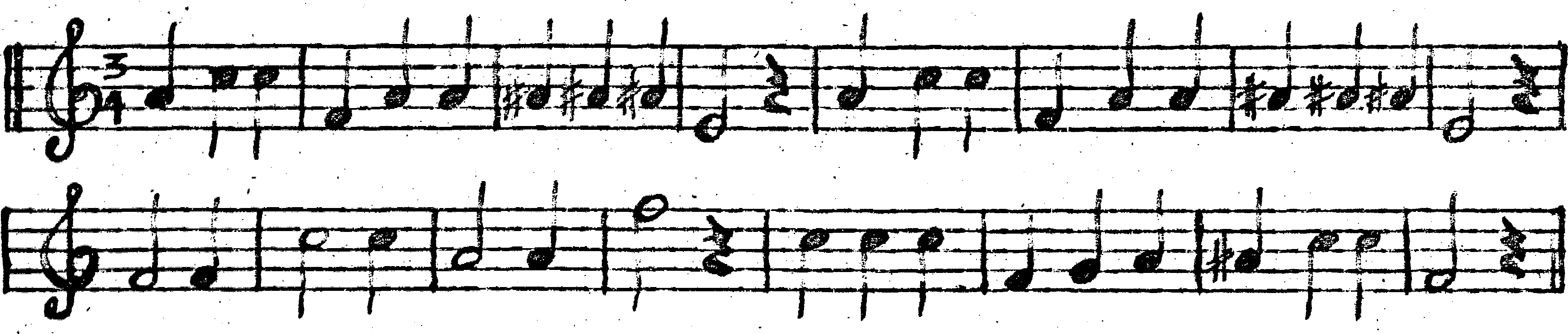
When I was single, I lived at my ease;
But now I am married, a husband to please,
With three small children to maintain:
Oh, how I wish I was single again.*
One cries, ’Mama, I wanna-go to bedi "
Another cries, "Mama, there’s a louse in
■ my headi"
I wash them, and dress them, and put them
to bed; . .
Along comes their father, a-wishing they
were deadi***
♦This song, which has a fascination for women collectors, seems,
strangely enough, to leave the men of the cult cold. They gen¬
erally ignore it, and so there are no further references.’
**The last four hundred years have been marked by woman’s rebellion-
against man’s intrenched superiority and privilege. This has been
especially true in America, where, because of pioneer conditions,
with the breaking down of old ideas and the fusion of many cul¬
tures, there has been much social and economic experimentation.
Here, because few in number and greatly sought after, they success¬
fully sold their favors// to their eager and numerous suitors^ for
greater and greater concessions. They had bargaining power because
they were a scarce item in a place of great demand. Yet, in spite
of their expanding horizons, the women of America continue to be
the most malcontent in the world. A taste of meat has only wrhst-
ted their appetites.’ For they, are in the unhappy position of hav¬
ing to choose between career and marriage or of attempting a stor¬
my compromise. For the two are iroomoatihl©. Love means self-
aacrifice and loss of, personal id entity career means ego satisfac¬
tion and personal fulfilment.
***This is obviously the Freudian Oedipus complex.
Sea Ballad . . Child, No» 286*
9.
THE LOWLAND LOW
(Secured from Elmer Mar ley, of McCammon, Idaho, in the spring of 1933)
This version of what is more commonly known as "The Sweet Trinity"**
was brought to me, at McCammon High School, by one of my students,
Elmer Marle'y. Soil of a Blackfoot farmer, he boasted descent from a
powerful early-day Indian chief.. His grandmother, who lived at McCam¬
mon, had dictated the words to him from memory, but he was unable to
carry the tune. My father, Leff Larson, of Maiad, Idaho, supplied the
music in 1950, which he had heard sungp there,at a. dance, by one^Ed
Jenkins^, about 1890. He knew the song as "The Bold Turkish Crew."***
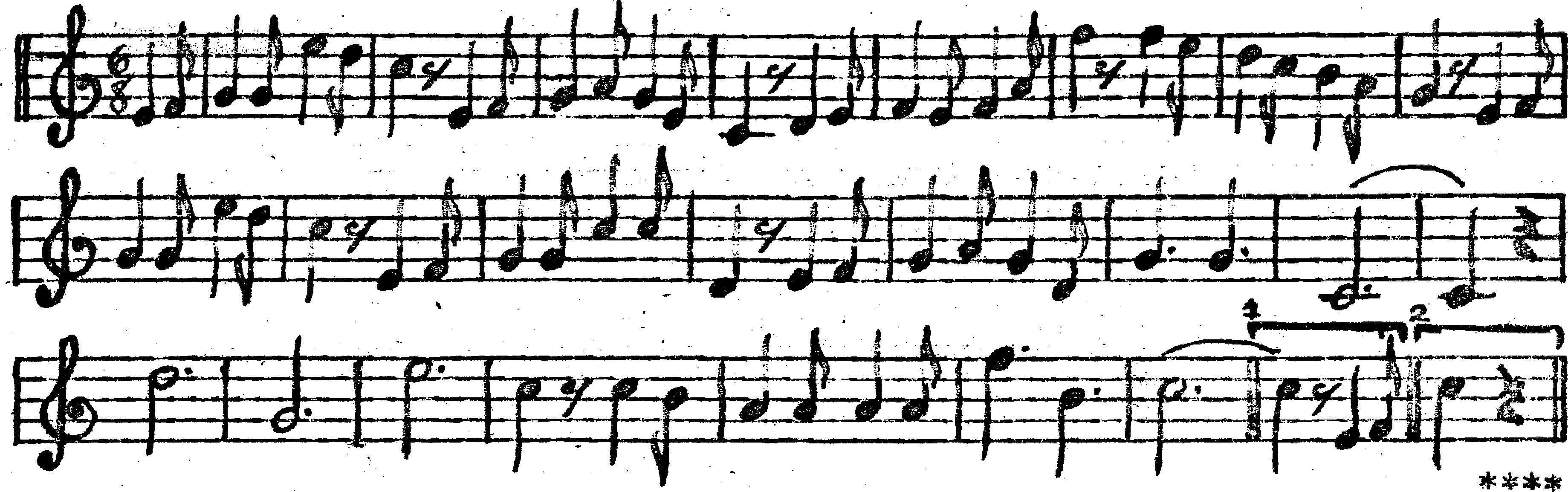
I have'me a ship in the north Countree;
She sails by the name of the Nanay Lee;
I'm afraid she'll be taken all by the
British crew
As she sails along the Lowland low.'
As she -sails along the Lowland lowi
As she sails along the Lowland lowi
Our bold Captain Stewart he did. speak,
A-stamping of his feet upon the deck:
"Is there any br&w fellow that ship
will destroy
As she sails along the Lowland low?
As she sails along the Lowland, low?
As she sails along the Lowland low?"
The first that spoke up was a'little
cabin-boy,
Saying, ’Captain, what will you gie me
if I destroy?
Will you gie me money, or will you gie
me store, '
If I sink her in the Lowland low?
If I sink her in the Lowland low?
If I sink her in the Lowland low? "
The newt spoke up the captain with a
look of joy,
A-making of promises to the little cab¬
in-boy:
"I will gie you money, I will gie you
store,
If you sink her in.the Lowland lowi
If you sink her in the Lowland low.'
If you sink her in the Lowland low.'
(9, The Lowland Low)
The boy" he took an auger and overboard
jumped,
Bent his breast against the waves and gal¬
lantly swum
Eight up tor the side of the British' ship
so bold,
As she sailed along the Lowland low,
As she sailed alone the Lowland low, -
As she sailed along the Lowland low*
The boy he took the auger and bored it in
twice,
labile some were playing cards and others
............ playing dice;
H« dazzled all their eyes when he made the
water flow;
And they sunk beneath the Lowland lowJ
And they sunk beneath the Lowland lowi
And. they sunk beneath the Lowland low;
Then he returned to his own Captain; s ship*
His strength began to fail him and his
courage began to slip;
”0h, Captain,'oh, Captain, don*t turn away
so,
For I*m sinking in the Lowland low!
For I lm linking in the Lowland, low*
For Ilm sinking in the Lowland, lowi ”
"Pick you up? ” Cried the Captain; ”Nq, that
will never bel
- I111 slash you, and shoot you, and sink you
in the seal”
Then.he turned away his head from the lit¬
tle cabin-boy,
And he sunk beneath thé Lowland lowi
And he sunk beneath the Lowland, lowi
And he sunk beneath the Lowland lowi
Ihe mates they picked him up, and on the
deck he died;
They wrapped him in his hammock so long and
wide;
They dropped him overboard,;and he sunk be¬
neath the flow,
As they sailed along the Lowland low,
As -they.sailed along the, Lowland low,
As they sailed along the Lowland low!
♦This popular ballad is known in various versions also as The Gol¬
den Vanity,” "The French Galley,” "The Turkish Galley,” and ”Bd~
, niund in the Lowland Low.” See. the following:
Primary -References.
Child, Ko. 286 ~
Gardner & Checkering, Ko. 88.
Henry, No. 27, p. 127
Cox, Ko. 15, p. 52
Sharp, Vol. I, Ko.” 282, p. 282'
Campbell a Sharp, Ko. 55
Secondary References
Greenleaf à Mansfield, p. 43
Ifyman & Brookway, p. 72
Flanders & Bromi, p.'230
Beiden, Ko. 78
Hudson, Ko* 22
McGill, p. 97
(9, The Lowlands Low)
♦♦Child lists numerous references for this ballad* It has been wide¬
ly known, apparently, in both England and Scotland since the days
of Queen Elizabeth* In fact, it was probably written as a broad¬
side in honor of Sir Walter Raleigh, for some versions, like that
'of, Pepys (Pepys Ballads, IV, 196, Ho. 189, 1682-85), use his.name
in the title. Sir Walter Scott was familiar.with it, arid .it is to
be found in practically every important collection, both in England
and America* See the references in the first note*
♦♦♦My. father claims he heard ^Ihe Bold Turkish Crewfi only once*
It
was at a country dance, where, in the intermissions, some local or
visiting person with singing talent would often be called on to per¬
form* The singer, in this .instance, was a Welchman named Ed. Jenk¬
ins* Father remembered the tune, however, and some of the refrain,
because' he himself was a violinist, who played, at the local dances*
Born in 1879, at St. John, a little country community four miles
west of Mai ad, hs had. grown up in the midst of pioneer conditions*
At a very early age, he had taken music lessons from the local
teacher, Professor Thomas S* Thomas. This man organized most of the
early-day bands and choirs of Malad Valley. Weekly .practice meet¬
ings were held in the evenings of wintertime. During summer^ every¬
body was too busy with sowing, cultivating, and harvesting. Evan
Stephens, who preceded Thomasy in St* John, was his uncle and also
his teacher. He later became famous as leader of the tabernacle
choir in Salt.Lake City. (incidentally, Evan Stephens remained a
bachelor till his death, because, in his youth, he had inadvertently
killed his childhood sweetheart during play practice for a comntun-
. ity theatre, when the part called for him to throw a knife at her.
He was a philanthropist, however, and gave college educations to
. many young men, including some of the sons of Thomas S* Thomas.)
But, to get back to the subject, the community singing practice in
St, John was usually a wintertime activity, and took place either in
private homes or in the school-house, which served also as church.
The first church, was a dug-outs replaced as soon as pos¬
sible by a log room* Amusements were few in those days, and the peo¬
ple had to depend on themselves for entertainment. Those who could
sing or pla7/ musical instruments did so and were held in high es¬
teem. Country dances were many and rough, held usually in the school
house. At first,^ candles were used, each thrust into a hole in a
potatq^ and set on a shingle slid between the logs of the walls.
La-teriT kerosene lamps were introduced. The dances were principally
quadrilles, reels, and hoe-downs. Sometimes.f)local comedians would
do an impromptu jig- Between dances, however, while the musicians,
usually a violinist, a clarinetist, and. maybe an accordion player,
were cooling off, the men would jump nn the knots in the plank floor
to drive them back down, as ...they would, work up with the dancing.
Drink abounded, and,>0whan rivalry occurred over pretty girls, men
. often broke out in brutal fighting. It was under these conditions
that the old ballads, brought from England and Wales, were revived
and popularized. And somwtim.es the local singers, who were often
.comedians^ as well, would add to their repertoire humorous son^s of
their own composing, - which, would become community prorert^gpand would
.eventually survive as folksongs* Old-timers, their ranks rapidly
thinned by death, are alone able, to yield up this vanishing treasure*
♦♦♦♦This tune does not fit the Mar ley words very well. Tee refrain is
too long. 1 understand the version my father heard went somewhat as
follows:
**As she sailed along the Lowlands low*
Lowl and s, L owl and s ,
As she sailed aim.? the Lowlands low.
Animal Ballad Child, No* 26*
10# *
THE TWO CROWS**
(Learned in childhood, about 1912, at Malad,Idaho, ‘from my parents)
As. far back as memory goes, I recall‘hearing; this song; frequently
at home. It is course, a version of Child ’s wThe.. Twa Corbies •”
Both of my parents loved to reminisce on their own childhoods. And my
mother, in particular, cherished all the old ballads ‘which had pre¬
vailed in the house of her father. I'always believed that most of
these were brought from England by my Talbot ancestors, (See No. !•)***

There were two crows sat in a tree,
In a tree;
There were two. crows sat in a tree,
In a tree;
There were two crows sat in a tree,
In a tree.,
As black as any crows could, be.
Crows could be.
The one crow whispered to his mate,
To his mate;
Brie one crow'whispered to his mate,
To his mate;
Baa one crow whispered to his mate,
To his mate,
Wlave you seen anything to eat,
Thing to eat?”
"Biere lies a horse in yonder field,
Yonder field;
There lies a horse in yonder field,
Yonder field;
There lies a horse in yonder field,
Yonder field,
And there we’ll have a merry meal,
- Merry meal J "
’We’ll perch upon his old backbone,
Old backbone;
We’ll perch upon his old backbone,
Old backbone;
We’ll perch upon his old backbone,
Old backbone,
And peck his eyes out one bv one,
One by onel”
| *See the following references* | |
| Primary | Second ary |
| Child, No. 26 | Barry, Ho. 27 |
| Sharp, Ho. 11, p. 63 | Cenrobe 11 & S-iarn, ITo, |
| Henry, Ho. 7, p. 48 | Flanders >h Brrv.-m, n. |
| Cox, ITo. 5, p. 13 | Hudson, Fo. 6 |
(10, The Two Crows)
♦♦Child gives a good account of this ballad. Seemingly, it was first
printed in 1611, in “Rave ns croft 1s' Melasmata. But it may have
been
already in existence for a long time# Its continued and widespread
popularity was pointed out.*? In 1855^ by Chapoe 1 in his Popular
. Music of the Olden Time. Sir Walter Scott had called it a counter¬
part, of "The Three Ravens*" His version of it appeared in 1803 in
his Minstrelsy of the Scottish Border* And the several references^
above^- indicate that today*, In America,, it is stj.ll very much w
alive* , I have even seen, it in a Boy Scout song^book.
***I heve reason to believe that many pioneers of Utah and. Idaho were
ballad addicts*. Leastwise, such was true of the numerous branches
of the Talbot family, which spread out from the original, home in
.Kaysyille.., Utah. For in those days, when movies and radio were un¬
known., people were .forced to depend on themselves^and • on their
friends^' for the entertainment for'which they were starved. Often^
' there Yifas considerable -distance -between neighbors, though, being
from densely settled areas in Europe, most preferred to live in lit-
u tie communities made up, perhaps, of a dozen or more log-cabins. In
most cases, the men-folks had built the houses themselve's, with logs
, they, had gotW» out of~the nearby canyons. All were very busy in
clearing^away sage, farming their land, and jSIt fighting off the on¬
slaughts of crickets and • jack-rabbits • And the women, of course,
were equally well occupied, what with making soap, drying fruit,
• preserving meat, weaving and spinning, and keening the large and
growing .family fed three times daily. But, fortunately, the work
was healthful, andj? in moments of relaxation,, everybody played with
■ 'equal vigor^ and enjoyed the meagre pleasures with an Intensity sel-
• dom seen today* Sociability was widespread and genuine. And the
sudden appearance of a stranger at the door was greeted with great
joy*-. In isolated-regions, it was common for whole families to pile
I into their wagon, and, taking along plenty of food, drive offrTor~
a
week^s visit with some distant neighbor or relative. Such visits^
too, elicited wild joy. Die children^-, in particular^-were starry-eyed
at the prospect of hearing grown-up "gossip, and of doubling up, many
to the bed, as likely as not on a dirt floors or in a wagon-box, a
granary, or a hay-stack, with their numerous cousins. The art of
conversation was highly developed, and, during such visits, everybody
would have his fill of listening^ eagerly,->to tales of personal ad¬
venture. That these were greatly exaggerated, making of the teller
something .of a hero, mattered not at all. Foyp the more thrilling
the story, the more entertaining it was. Thus, the times were highly
favorable for the growth of folk^tales.,;, and also for the perpetuation
of old songs and ballads. In the evenings# after the old-ti^wrs had
exhausted their tales, and themselves, out would come the fiddles and
banjos, and there would be music and singing. And those who were
able to do a good lively song with a story were greatly esteemed.
Maybe there would also be a bit of dancing, with everybody .crowded
up, as thick as fleas, in that one little cabin room. And the young
folks would be in their glory. Always, of course, while the fun was
at its height^, and while everybody was working up an appetite, the
mature women of the group would be preparing a simple meal, but a
meal the most savory and abundant imaginable. Hunger was the sauce
which made it so tasty that, years afterward, wh°n themselves grown
old, those children recalled the experience with joy. fnxs, then,
is a picture of that pioneer social life under which the popular bal¬
lads, brought to America from the home country, flourished. It is a
picture which 1 have reconstructed from, the accounts of my father and
mother, who both 1ived in pracissly such hones.
Sea Ballad
11.
ANDY BARDEEN**
Child, No. 167*
(Learned by Father, 1900, Pocatello Valley, from Abraham Steven Hansen)
My father, Leff Larson, learned this ballad, known to Child as
"Sir Andrew Barton, " under the same circumstances as "The Jollv Shep¬
herd,11 (See No. ^.) He was at the time herding;'sheep in Pocatello
Valley,, a short distance west of Malad. And his companion in that lone¬
ly sheep-camp, Abraham Stephen Hansen, made the hills echo with the
strumming; of his banjo to many such songs«***

There were three brothers in old Scotland;
Three loving brothers were they;
They all drew lots to see which one
Was to go robbing out on the salt sea.
The lot it fell to Andy Bardeen,
The youngest of the three;
He was to go robbing out on the salt sea
To maintain his.two brothers and he.
They had just sailed now two winters nigh
When- a big ship they did spy,
And she came sailing around and around
Until she came sailing ouite nigh.
”Who;s there, who;s there?" cried Andy
Bardeen;
nS?ho1s there;. I ask of thee?"
f*We are three merchants from old England.
Now, please, won’t you let us pass by?"
"Oh, no; oh, hoi" cried Andy Bardeen;
"Oh, that could never be i
Your bright shining: diamonds we111 take
all away,
And your ship we *11 sink in the seai "
Eight there and then the battle began;
Bright cannons they did roar; .
They had only fought an hour or so
i*hen the three rich merchants gavu o’er.
The news -was brought to the Ring of France,
For he was ruling the land;
He offered rewards to any man
That would bring Andy Bardeen to land.
1?0h, build ms a ship, " says Captain Charles
Stewart;
"Oh, build it strong and -firm;
And 1 vwLll brixxg Andy Bardeen to land,
Or my body will never return.1"
(11, Andy Bardeen)
Ha had but sailed just three winters nigh
. Whan a. big ship he did spy; .
And she came sailing around and around,
Until she cam« sailing ouite nigh.
"Who's there? Who's thePe?" cried Captain
Charles St e-wart-;
’Who's there, I ask of thee?"
•We are three robbers from old Scotland.
How, please, won't you let us pass by?"
"Oh, no; oh, noJ" cried Captain Charles
Stewart;
"Oh, that could never bei
"lour bright shining diamonds we'll taka
. ..all away,
"And your ship we'll sink in the sea;"
"Come on; Come on;" cried Andy Bardeen;.
"rfe f«ar you not one pin.'
For you’ve got brass without your grand
ship,
But ws've got steel within.' "
Right there and then the battle began;
Bright cannons they did roar;
They had just fought about an hour or so,
■When Captain Charles Stewart gave o'er.
"Go backi Go back.'" cried Andy Bardeen;
"And" tell the King for me
Biat he may be ruler of all the great land,
But I'm still king of the sea.'"
♦Child also has a version of this ballad called ’Henry Martyn," but
the conventional title is
m nary References
Child, Nos. 167 & 250
Gardner 6s Chi clearing, No* 81
Eddy, No* 24, p. 78
"Sir Henry Barton* " See the following:
Secondary References -
Mackenzie, p. 61
Barry, pp* 248-258
Cox, No. 26, p. 150
♦♦Numerous references, both ancient and modern, testify to the poru-
laritv ’of this ballad. Child discusses its origin in his consis¬
tently scholarly fashion. It seems that^ in actual history, on«,
Andrew Bartoi^p received letters of reprisal against the Portuguese
from the kins; of Scotland, because they had seized a ship comman¬
ded by his father* He, however, abused this privilege, andj? in
1511y Sir Thomas and Sir Edward Howard, with the consent of Henry
VIII, set out to destroy him. Barton was killed in a furious sea
battle, and his shin, the Lion, was captured* The subsequent de¬
mands of the king of Scotland for redress were refused on the
grounds that Barton ms a pirate. This balled, which commemorates
the story, has had wid« circulation, not only in England and Scot¬
land, but in America as well.
♦♦♦The life of a sheepherder is a lonely one. At best, he has but one
companion, and often he is alone save for the infrequent visits of
the camp-tender. He cooks his own. meals and sleeps in the wagon
camp or on the ground. Around him are prmt smanses or the clos¬
ing in hills. He must,' of course, guard his flock night.and day,
lest they stray, find -quicksand or noisonous plants, or fall victim
to the ever nntchf ul covote. At ni ght h e has the stnrs for con-
par y, and it is town ha resorts to his muitar#
$ümorous Ballad
Eddy* No. 87*
12.
THREE MSN *
(Secured from Elmer Mar ley* of McCammon, Idaho, in the spring of 1933)
This folk-song is not as widespread as many. I found it in only
four collections, though it may be in others. My manner of acquiring
this version, which differs somewhat from those in print, is identical
with already discussed, ”The Rowlands Low.” (See No. 9.) Elmer
Mar ley, one of my high school students, brought it to class, at my re¬
quest, to fill the requirement for a theme. ,

Three men went out a-hunting,
And nothing did they find
Until they came to a windmill,
And that they’ left behind*
The Irishman, says, "Windmill;"
The Scotchman he says, "Nay;”
The Dutchman says, T,1Tis a mighty fine thing
To keep the birds away.1”
Three men went out a-hunting*
And nothing did they find
Until they came to a bull-frog,
And that they left behind•
The Irishman says, "Bullfrog;”
The Scotchman he says, "Nay; "
The Dutchman says, "Looks like a turtle-dove
With his feathers all blown away! ”
Three men went out a-hunting,
And nothing did they find
Until they came to a porcupine,
And that they left behind;
The Irishman says, "Porcuoine; ”
The Scotchman'he says, "Nay; "
The Dutchman says, "Looks like a pin-cushion
With the pins stuck in the wrong wayi "
Three men went out a-hunting,
And nothing did thev find
Until they came to a iack-ass,
And that they left behind;
The Irishman says, "Jackass;"
The Scotchman he says, irNay; ”
The Dutchman says, "It’s Franklin D. Roosevelt:
I can tell him by his bravi”
Three men went out a-hunting,
And nothing did they find
Until they came to Idaho,
And that th°v left behind;
The Irishman says, "I^a^o;"
The 'Scotch man h -a says , ,rNey •
The Dutchman says, .,f,Tis a mighty fine place
To keen the bums awayj ”
also Flanders, No. 8; Fuser, n
mm, n. 125.
P g * T? ~] n y] p <3 7«
Outlaw Ballad Lomax, No* 81
13.
sam BASS
(Secured from Elmer Mar ley, of McCammon, .Idaho, in the spring: of 1953)
I acquired this song, also, from Elmer Mar lev, one of my students
at Mo Gammon High School. But he did not know the music* John A. Lomax
in his Folk Song U.S.A» t gives a detailed account of train and bank
rob
ber, Sam Bass, who, betrayed by Jim Morphy in 1878, was killed by offi¬
cers of the law* His life was somewhat like that of Jesse James*
Sait Bass was born out in Indiana*
That was his native home;
And at the age of ■ seventeen young,
Sam began to roam*
He first went out to Texas,
A coxfboy for to be;
And a more tender-hearted fellow
You hardly ever see*
Ha used to coin the money,
And you bet he scent her free;
He always drank good whiskey
Hherever he chanced to be*
Sam once dealt in race-stock;
She was called the Dalton mare;
Matched her at the scrub races
And" took her to the-fair*
Sam left the Dalton ranch
In the merry month of May
With , a herd of Texas cattle,
The Black Hills for to see.
Sold out in Custer City,
And then go- on a spree;
And a tougher set of cowboys
You hardly ever see.
On their way back to Texas
They, robbed a U*F. train,
Split up in couples,
And started out again*.
Sam was hiding in the bushes,
A-trying to get away;
Tom borrowed Sam’s good gold,
And then he refused to pay.
Sam Bass, as well as his rar^ner,
Was overtaken soon;
And with all their hard cash-money,
They had to meet their doom.
They were carried to "Lhe city,
And there locked un-in d^il;
With all their gold and silver,
They couldn*t a*et out on hail*
It was on a Surrey morning,
They mrs hanged nt break of day*
And that was the end of vour^ 3am Bnss •
In ere * s not h i r mor e to s ay •*
Unhappy Love Ballad
§ardner & Chickening , No. 45*
14.
LAKE OP PONGATRAIÍT
(Secured from Murray Hale, of McCammon, Idaho-, in the spring of 1933)
This :ballad£> according to .Gardner, and. Chickening-is- at least as
old as 1890.. Murray Halé, one of my high school students, came up
with this version, which .he‘Claimed -was dictated - to him by his parents.
His father was a railroad man from pioneer stock#
rTwas on a bright May morning
I bid Orleans adieu
And started out for Jackson,
flhere I was forced to go.
Through swamps and alligators
I was on my weary way;
Over railroad, ties and crossings
My weary feet did stray,.
Till 1 long 1oarar d shades of evening,
The higher ground I gained•
*Twas there I met the Creo girl,
On the Lake of Pongatrain.
"It’s good eve to you, fair maiden;
My money does me no good;
If it wasn’t for the alligators,
I*d sleep out in the wood.”
"It’s welcome, welcome, stranger;
Our cottage is but plain;
But we never turn a stranger out,
On the Lake of Pongatrain. ”
She took me to her mother Ts house
And treated me nuite well;
Her hair in golden ringlets
Around her shoulders fell.
I tried to paint her beauty,
But I found it was in vain,
So handsome was the Creo girl
On the Lake of Pongatrain#
I asked her if she’d marry me;
She said that never could be;
She said she had a lover
That was out upon the sea.
She said she had a lover,
And ture she would remain
Till he came bcck to-the Oreo girl
On the Lake of Porgatrain.
"Then it’s farewell to you, fair maiden;
I never shall see vou '^ore;
But I111 never forget your kindness,.
Hor the cottage by the shore.
And %vh«n in single blessedness
...... . The flowing bowl .1 drain,
I’ll drink my health to the Creo girl
On the Lake of Por^atrainf
*3ee pourr
no.
Outlaw Ballad
Eddy, Ho. 85
15.
THE BOSTON BURGLAR
(Secured from Claude Bullock, McCammon, Idaho, in the spring of 1933)
Claude Bollock was another of my hisrh school students. His home
was at Readyville, however, a small place near McCammon but off the
main highway. X think he learned this version of *The Boston Burglar”
from his family. Cox says this ballad, a version of the English one^*
"Botany Bay,” was published in the U..S. as a Tfehman broadside.
I was born in Boston City,
A city you all know well;
Brought up by honest parents;
And the truth to you I'll tell.
Brought up by honest parents,
But my friends they dragged me down;
For the robbing of the Boston Bank
I'm here in Charlestown.
I started out night-walking,
And also drinking rum,
Paying calls at the whorehouse,
And robbing just for fun.
The judge he gave me a sentence,
And a long time I will be
A-serving out those twentv-bne years
In the penitentiary.
They put me on an east-bound train
One. cold November day;
' And at every station we would pass,
I'd hear the people say:
"There goes a noted burglar;
In irons he 'll be bound.'i
For the robbing of the Boston Bank
He's headed for Charlestown!”
I've got a girl In Boston,
And I know she loves me well;
If I ever get out of this lousy jail,
Along with her I'll dwell.
My father is a drunkard,
'hasting his time away;
My mother's in the cold, cold ground;
They buried her the other day!
My sister's in a whorehouse;
The family's broken down;
For the robbing of the Boston Bank
I'm here in Charlestown;
♦See the following primary and secondary references?
Gardner A Chickering5 No. 137 Flankers A Brown, pp. 53-54
Eddy, No. 85, p. 204 . Scarborough, pp. 2ts9-296
Cox, No. 29, p. 89 Cambiare, p. 69
Ccwbov Ballad ■ - Lomax, Ho.
. • 16.
YIPPIE YAY
I found those two versions under different circumstances. The
first came from rhenoi De'schamps, an adolescent of St. John, Idaho,
vA10, being a local comedian, had cuite a repertoire, chiefly of vulgar
songs. The second .was recited to me, by my. student, Bar, Infanger, at
McCammon. The latter told me that his father, the-eourCe, who was an
early-day freighter between Utah and Montana, learned the song at a
Soda Springs round-up. ¿he cowboys, who knew little of it, improvised
freply as they worked, -various ones contributing lines. Both versions
are sung to the tune of Lomax’s familiar "Chisholm Trail.”*
A.
(Secured from Fhenoi Deschamps, of Malad, Idaho, in the fall of 1932)
.1 was coming down the mountain by the old cow-trail,
■With my rope in my hand, and a heifer by the taili
, Come a ti-vi-yippie, yiopie-eye, yippie-yay;
Corns o. ti-yi-yippie, yipnie-vayi
Saddled old Bollie and started down the trailj
He threw me off in a fresh cow-pileJ
Come a ti-yi-yippie, yinnie-eve, yinpie-yay?
Come a ti-yi-yippie, yippie-yayi
Last time I saw the boss (I haven’t seen him sincei),
He was branding** a heifer through a barb-wire fence 1
• „ Etc.
I jumped in a wagon, and I gave a big yellj
The team ran away and broke it all to hell!
Etc.
!
And now my song is ended; I can sing you no morej
There*s an apple in my butt, and you can have the corei
Come a ti-yi-yippie, yinrie-eye, yippie-yavj
Come a ti-yi-yippie, yippie-yayi
B.
(Secured from B©n Inf anger, of McCammon, Idaho, in the spring of 1933}
Way up north among the bear and lyonj
Come dovm south a-shoutin1 and a-cryini
Come a ti-yi-yippie, vippie-eye, yirrie yay;
Come a ti-yi-yipnis, yippie-yayi
Feet in the stirrup and my butt in the saddle,
A-singing all day to your ✓God damned cattle.1
.Stc.
I went to the boss to draw my roll
To go down south and find a shady knoll.1
Etc.
The boss came out with a gun in his hand,
A-saying: ,fGret to rork and be Cod damned; tT
Etc.
Well, I horned on the stage, and I gave a little yell;
The l^ad-bars broke, and the loaders vent to belli
Cone a ti-yi-yinnie, vitro ie-eve, virrie-yay;
Come a ti-yi-yirrie, yippie-yayi
Bible Ballad ' Scarborough, p. 180*
17.
CRBATION
This ballad, too, comes from various sources. ¿33d Dorothy Scar¬
borough collect iony attributes Its origin^to the Negroes of :the
South, -wiiere it is widespread and popular. It' seemsto have
been an early-day favorite in Malad Valley, if not in all eastern Ida¬
ho. My first version was' contributed by Lenore Morris, a high school
student at McCammon, who learned, it from her family. My second was ob¬
tained from Johnnie Deschemes and Mr, and Mrs. Dave Edwards, all born
.of pioneer parents, in the Malad region. My father, Leff Larson,
claims that he also knew this version, jis a Jfouth. It was sung fre¬
quently by his brother-in-law, David ST.......Thomas/# of St. John, who was a
lively entertainer in early pioneer days, and used to charm the crowd
with it at parties, dances, and local celebrations. At one time, every¬
body in St. John knew the song. The third version was a favorite of my
room-mate# Lester Bush^^Lem of Malady when to were at school together
at £Ke Southern Branch, Pocatello, Idaho, in the winter of 1927-28.
Only he, of all those contacted, gave me a tune.**
A.
(Secured from Lenore Morris, of McCemmon, Idaho, in the spring of 1933}
Adam was the first man;
Eve was his spouse;
They got married
And went to keeping house.
five took an apple;
Adorn did the same;
They got kicked out of Eden,
‘And they went to raising Cain.
Samson was a boxer
In the pugilistic school;
He killed a thousand Phillistines
With the fragments of a mule.
Along came Delilah,
And she filled him up with gin;
She cut off his whiskers,
And the cops they ran him in.
Daniel was a Hebrew,
And he- wouldn*t mind the king;
Tile king he said he wouldn*t stand
For any such a thing.
They threw him in a, lion's den,
With lions down beneath;
But Daniel v/as a dentist,
And he pulled the lion's teeth I
Jonah was a jailbird
Until he jumped his bail;
He took a steer aye passage
In a trans-Atlantic whale•
But in the whaleTs belly,
where Jonah got depressed,
Jonah pushed a button --
And th9 whale d5w the rest!
(17, Creation)
B,
Talking in the Farlor
(Contributed, 1932, by John Deschamos & Dave Edwards, of Mai ad, Idaho)
Adam was the first man;
¿ve was the tother;
Cain he walked the treadmill
Because he killed his brother,1
Chorus:
It’s miking, then, it1 s walking,
Walking, I say;
Walking through the parlor
For to hear the banjo play;
Walking through the parlor
For to hear the banjo ring,
And to watch the darkle's fingers
As he plays unon the strings /
The world was made in six days,
And then they mads the sky;
They finally hung it overhead
And left it there to dry/
All the other animals
Were molded one by one
And set against the fence to dry
As fast as they were done]
But old Mother Sve couldn*t-
31eet> without a oilier;
And the greatest man that ever lived
Was Jack the Giant Killer I
C.
Alimony
(Secured from.Lester Bush, at Focatello, in the winter of 1927-28)

Oh, Adam ms the first guy that ever was invented;
:IIe wandered all around., and he never was contented;
They malm him out of clay in the days rone b^r,
Anrl they hung him out in the sun to dry/
Oh, alimony, I wanta live, anyway, till I die/
And then came Eve, and. they had, an awful battle;
She chased Adam un a fr^e to get an anole;
Adam ate two, and he gave &ve one.
And that is how all the trouble begun/
Oh, alimony, I wanta live, anyv?ay, till I die/
(17, Creation)
And then came Cain, and live was his mother;
He stumbled all around till he found himself a brother;
The good Book says that Cain killed Abels
He hit him in the head with the lei?; of a tab lei.
Oh, alimony, I want a live, anyway, till I die!
And then came Noah a-stumbling in the dark;***
He found a saw and hatchet, and he built himself an Ark;
Then came the animals, two by two,
The hippo-hippopotamus and kangaroo!
Oh, .alimony, X want a live, anyway, till I die.'
Then it rained for forty days and forty nights- without
a-stopping;
The damned old boat began a-leaking and a-rocking;
The ocean got rude, _and the waves got rank,
And the whale threw Jonah on the sandy bank.'
Oh, alimony, I want a live, anyway, till I diei
And then came Roosevelt a-looking for a bear;
He searched the Mississippi, and. he couldn't find him there;
He went to South Africa, so I've heard,
And killed them with a fountain-pen at forty cents a-word/
Oh, alimony, I wanta live, anyway, till I die/
I once knew a doctor by the name of Peck;
He fell into a well, and he broke his damned neck;
It served him right --he should have stayed at home,
Tended to the sick, and left the well alone/
Oh, alimony, I wanta live, anyway, till I die/
I bought myself a pair of combination underwear
Just to keep out the damp and the cold and chilly air;
I wore them six months, without exasperation,
And when I went to take them off I found I'd lost the com¬
bination/
Oh, alimony, I wanta live, any'-ay, till I diei
I went down town for to see my gal Bess;
She said, "My honey, I am all undressed/"
’’Then slip on something and come down here/"
So she slipped oh a cake of soap and came down on her ear/i
Oh, alimony, I wanta live, anyway, till I die/
A horse and a flea and three blind mice
Were out in the barnyard a-gplaving dies;
The horse he slipped, and he fell on' the flea;
And the flea, said, "Golly, that's a horse on me/"
Oh, alimony, I wanta live, anyway, till 1 die/
♦Variants are also known as "Noah," "Old, uncle Noah," and "The Story
of Creation, " However, in the beginning', there were orobably two
separate Negro songs, "Noah^" and "Creation," which, in the course
of time, have been fused and confused, 1 have no words which seem
to fit the extant versions of "Noah" as such. See the folloxving:
Scarborough, pp. 180-182
Faskman & Spaeth, p. 202
** Idaho versions seem to mo back at least to 1890 and probably earlier
But the origin of "Alimony" is doubtful. It is probably much later,
and may actually be a phonograph,.record.
IIDEX
"Andy Bardeen." p. 19
"The Baffled Knight," p. 6
"Banks of the River Dee." p. 3
"The Boston Burglar." p. 24
"Bryan,61 Lynn." p. 7
Bujlock, Claude, p. 24
Colton, athel, p. 4
"The Cruel Miller," p. S
’The Danse 1 from Chasjiarr, " n. 4
Deschamps, John, pp, 23,27
Deschamps, Fhenoi,. p. 25
isdimrds, Dave, pn. 26-27
Bhrnfelt, Melba, n. 9
"The Frog’s Courtshin," p. 1
"The Golden Vanity," p. 14
Grant, Mrs. Frank, p. 7
Hale, Murray, p. 23
Hansen, Abraham Stephen, pp. 6,19
Infanger, Ben, p. 25
Jenkins, üid, p. 14
"Johnnie Dovle." p. 9
"The Jolly Shepherd. " p. '6
"Lake of Pongatrain." p. 23
Larson, Leff, pp. 6,7,8,11,14,17,19
Larson, Mrs. L9ff, pn. 3,11,17
"The Lowlands Low. " p. 14
Malad, p. 12
Marley, fiilmer, pp. 14,21,22
Marriage, p. 12
McCammon, p. 9
Morris, Lenore, p. 26
Pioneer Life, p. 18
Polygamy, p. 12
-Sam Basa," p. 22
Sheepherders, pp. 6,20
Social Life of St. John, pp. 16,26
"The Sweet Trinity," p. 14
Talbot, Andie, pp. 1,2
Talbot, Henry, pp. 1,3
Talbot, Katie, p. 4
Talbot, Miriam, p. 13
Talbot, Stephen Barton, pp. 1,3,5
Thomas, David S., p. 23
ÎE2 P,KQ%a» " p. .IT
"The T%dding Far tv. " p. 1
"The Wexford Girl, " p'. 3
IVoman Suffrage, p. 13
Ÿîïïhen I fas Single, " p. 11
nf ish I -ms Single . n n. 13
BIBLIOGRAPHY
1. Child, James Francis: The English and Scottish Popular. Ballads,
"The Three Ravens" (26)
"Tam Lin" (39)
"The Baffled Knight" (112)
‘Sir Andrew Barton" (187)
"Henry Martyn" (250)
"The Sweet Trinity" (286)
2. Cox, John Harrington: Folk Songs Mainlv from ’Test Virginia.
Folksong and Folklore Deoartm^nt, Rational Service Bureau: Pub¬
lication No. 81-3. (June, 1939).
"Mr. Mouse Went A-Courting" (22)
"Joe Bowers" (24)
3. Cox, John Harrington: Traditional Ballads from West Virginia.
Folksong and Folklore Department, National Service Bureau. Pub¬
lication No. 75-S. (March, 1939).
"The Crow Song" (5) ‘
"The Golden Vanity" (l5)
"Babes in the Woods” (22)
"The Boston Burglar" (29)
4. eddy, Mary 0.: Ballads and Songs from Ohio. New York: J.J. Augus¬
tin, Publisher^ (1939).
"Henry Martyn " ( 24)
"The Frog and the Mouse" (44)
"When I Was a Young Man" (69)
"How I Wish I Was Single Again" (70)
"Johnnv Doyle " ( 73)
"Old Uncle Noah" (75)
"The Boston Burglar" (¿5)
"The Murdered Girl" (104)
"The Three Jolly Frenchmen" (208)
5. Gardner & Chickering: Ballads and Songs of Southern Michigan. Ann
Arbor: The University of Michigan Press. (1939).
"Banks of the River Dee"(20)
’The Lost Johnnie Doyle" (69)
"Andrew Battan" (81)
"The Lowlands Low" (¿2)
"The Boston Burglar" (137)
"The Frog’s Courtship" (l89)
6. Greenleaf & Mansfield: Ballads and. Sea Songs of Newfoundland.
Cambridge, Mass.: Harvard University Press. (1933).
"The Highway Robber" (21)
7. Henry, Mellinger Jfidward: Folk Sorms from the Southern Highlands.
New York: J.J. Augustin, Publisher. Tl938).
"The Three Ravens" (7)
"The Sweet Trinity" (27)
"Johnnv Doyle" (40)
"The Wexford Girl" (64)
"The Frog and the Mouse" (144)
8. Lomax, John A., and Alans Folk Sprio-s U.S.A. New lork: 'Due 11,
Sloan, & Pierce. (1947).
"Old Dan Tucker" (27)
"Old Smoky" (60)
"Sam Bass" (81)
•"Buffalo Sals" (104)
‘'Mademoiselle from Armentiers " (122)
"Sweet Betsy from Pike" (176)
"Rye Whiskey" (218)
'Red River Valley" (220)
■ 9. Lomax, John A,j Cfar Sinking Country. New York: The Macmillan Com¬
pany. (1941).
"Tom Bolyn" (p. 117)
10. Paskman & Spaeths Gentlemen, he Seatedl
"Old Dan Tucker" (p. 42)
"Blue Tail Fly” (p. 191)
"Walk in the Bar lor" (p. 202)
11. Scarborough, Dorothy: On the Trail of Negro Folk Songs. Cambridge:
• Harvard University Press. (1925).
"Frog 'Went A-Courting" (p. 46)
"Noah" (p. 180)
"Story of Creation" (pp. 181-182)
12. Sharp, Cecil J.: English Folk Songs from the Southern Appalachians.
London: Oxford University Press. (1932")7
"The Three Ravens" (11)
"The Farmer's Curst Wife" (40)
"The Golden Vanity" (41)
"Babes in the Woods" (47)
"Edwin in the Lowlands Low" (56)
"Johnny Dovle" (83)
"The Single-Girl" (ss)
"My Billy Boy" (89)
"The Wagoner’s Lad" (117)
"Tom Bolyn" (151)
"A Frog He Went A-Courting" (220)
"The Frog in the Well" (221)
"Fihat Are Little Boys Made Of" (227)
"The Old Gray Goose" (236)
13. '¡tells, Evelyn Kendrick: The Ballad Tree. New York: The Ronald Press
Company. (1.950)...
"Hie Golden Vanity" (p. 53)
"The Three Ravens" (p. lbl-152)
"The Frog's Courtship" (p. 165)
"Brian 0‘Lynn" (p. 167)
"Sir Andrew Barton" (p. 232)